

Finding a New Anchor
Insights from my ILLUMENATE conversation with Tim Fullerton.

Every episode of ILLUMENATE teaches me something about being human. Some conversations quietly rearrange you. My hour with Tim Fullerton—digital strategist, co-founder of White Dudes for Harris, and co-creator of Find Out Media—was one of those moments.
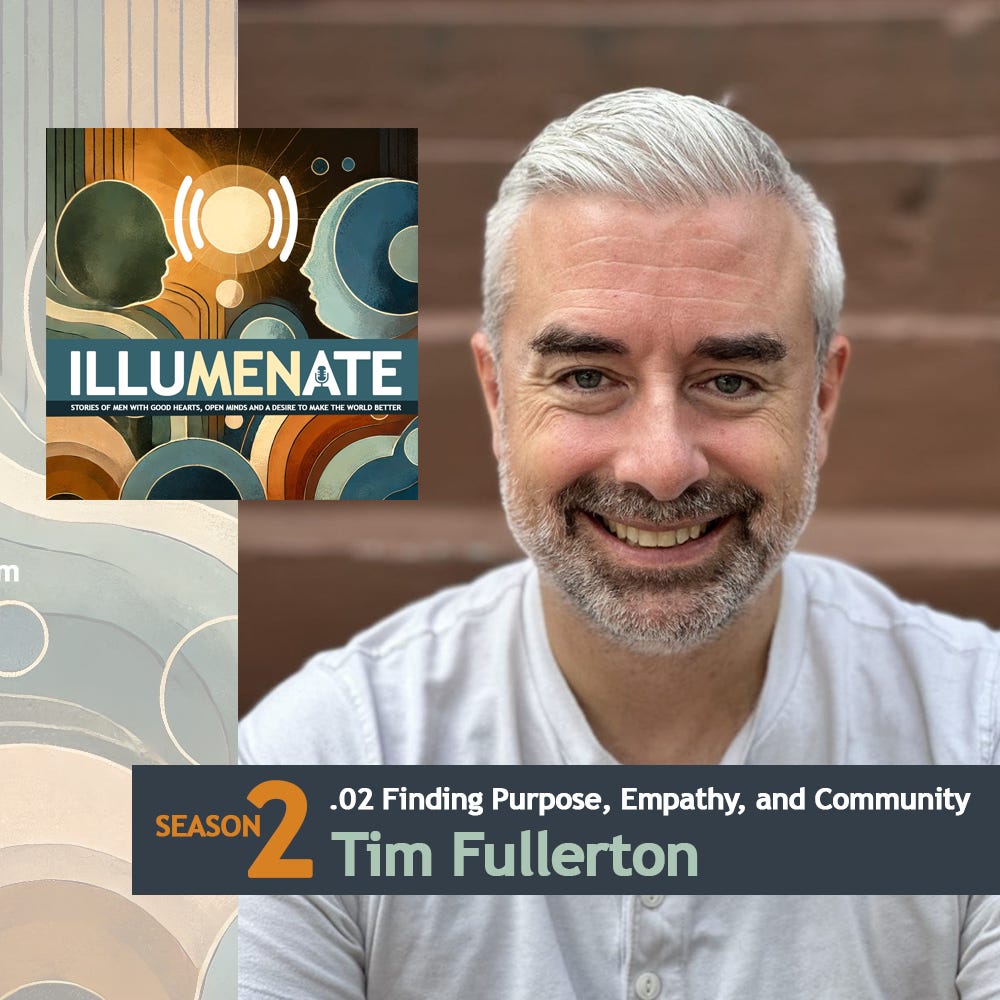
Tim came to the mic with decades of political experience, a surprising vulnerability, and a very modern mission: help men find healthier versions of masculinity in a world where so many feel unanchored. As he told me early in our conversation, “I’ve always been mission driven… trying to leave things a little better than I left them.”
Throughout our hour together, four themes emerged—each deeply relevant not just to Tim’s story, but to the broader journey many men are on as they navigate identity, purpose, and belonging in a rapidly changing world.
Purpose Is Discovered in the Doing
“Where I really get my kicks… is trying to leave things a little better than I left them.”
Tim’s trajectory—Obama’s 2008 digital team, major advocacy organizations, crisis-era WeWork, a million-download podcast—reads like an adventure novel built on restlessness and intention.
But none of it was preordained.
As a kid, he was the one reading the Encyclopedia Britannica for fun, the one who knew who the Israeli prime minister was in fifth grade. That curiosity shaped his path long before the world even knew what a “digital strategist” was. Later, when the Obama campaign called, he found himself stepping into what he describes as “the pinnacle of digital at the time”—and battling serious imposter syndrome.
“I walked into the Chicago headquarters… and I honestly had imposter syndrome. I’m like, what am I doing here? These people are all the best of the best. And then after a day or two, you go, no, they actually do need my help.”
That pivot—from “Why am I here?” to “I have something to offer”—is where purpose often begins to crystallize.
Many men feel pressure to have a calling figured out by a young age. Tim’s story suggests something far more humane and realistic.
Curiosity comes first. Opportunities come second. Clarity often comes last.
If you don’t yet know your purpose, it doesn’t mean you’re broken. It may simply mean you’re not in enough motion yet to discover it. I was well into my 40s before I truly felt a strong sense of purpose in my work and life.
The Quiet Crisis of Men and Community
“Isolation for men is a real problem… that is how men tend to get radicalized.”
Tim has spent the last few years staring directly into one of the most dangerous absences in American culture: the loss of male community.
He describes a pattern that will sound familiar to a lot of men.
In your twenties, there are built-in ways to connect—bars, rec sports, coworkers. As you age, you marry, have kids, move cities, or work remotely, friendships become harder to maintain. Commutes and kids’ schedules replace pickup games and happy hours. Meanwhile, algorithms stand ready to recruit lonely men into increasingly toxic online spaces.
“I moved to New York 10 years ago from DC. I had a lot of friends in DC, but I don’t have a lot of strong friends in the New York area… It is a real problem. Isolation for men is a real problem.”
That isolation doesn’t just breed sadness. It creates a vacuum that bad actors are eager to fill—people willing to weaponize men’s loneliness, anger, or confusion for clicks, money, or political power.
Tim talked about a friend whose progressive son still ended up listening to influencer Andrew Tate, soaking in a worldview where men are “saviors” and everyone else is the problem. Even in households with good values, the online pipeline is strong.
The solution isn’t just telling men to be better. It’s giving them somewhere better to be. Tim and the Find Out team are actively thinking about creating “offline, in-real-life events” and “third spaces” where men can gather without the default script being sports + drinking + emotional shutdown.
One of his favorite examples of healthy male community came from an unlikely place: an Oasis concert at a stadium packed with mostly men.
“There were men crying, tears of joy. Men with their sons… the crowd swaying… It was pure unadulterated joy.”
Strip away the band, and what’s left is the core human need: men in a shared space, feeling something together, without having to perform detachment. Men don’t just need more advice. They need more rooms where they can walk in and exhale.
In my own life, I’ve felt this acutely. When my son was in scouts, I had a built-in network of other dads to engage with on a weekly basis. When that disappeared, outside of some loose camaraderie around sports, my community of men dissolved. That’s a lonely place.
Deconstructing Old Masculinity
“It’s been co-opted into this pump your chest… very 1950s style definition of masculinity.”
Tim has a front-row seat to how masculinity is being sold online—and how far that is from what most women, and frankly many men, actually want.
He describes the modern bro-influencer formula: Be hyper-aggressive. Treat vulnerability as weakness. Promise status, women, and power if men just follow the playbook. Blame women (or “wokeness” or minorities) when reality doesn’t match the fantasy.
“The problem is… they finally find out that that’s not the way, but they’ve already been essentially red-pilled… And then instead of getting angry at the people who have been lying to them, they get mad at women for not accepting them.”
This isn’t just toxic; it’s tragic. It takes real fears (about money, status, dating, meaning) and channels them into resentment and entitlement.
Tim offers a radically different definition of masculinity:
“What I think masculinity is, is having a lot of empathy and having kindness and lifting up people around you who need help… You can be masculine, be comfortable with who you are, and still support people of color, the LGBTQ+ community. We don’t need to put people down in order to lift ourselves up.”
That’s not a soft downgrade from some “stronger” version of manhood. That is strength. Empathy takes courage. Kindness demands self-control. Lifting others up requires a confidence that isn’t threatened by someone else’s success.
Tim also named something many men resonate with but rarely say out loud: the need to deconstruct how we used to talk and think.
He remembers casually using slurs as a kid—words targeting disabled people and the LGBTQ+ community—not out of malice, but ignorance. I can certainly remember those hateful words coming out of my mouth as a kid. Tim’s experience and mine mirror each other here. College and exposure to different people inspired us to confront how harmful that language is.
Some men never make that leap. The world changes, but their internal script doesn’t, and they’re left angry at a culture that no longer validates their old patterns.
Deconstruction isn’t about endless self-flagellation over the past. It’s about seeing the harm clearly, choosing to grow, and accepting that being a good man today requires different skills than it did 30 years ago.
Vulnerability, Loss, and the Fear of Letting People Down
“My biggest fear is letting people down… or letting myself down.”
Some of the most powerful moments in our conversation had nothing to do with politics or digital strategy. When I asked Tim about his least favorite emotion, he didn’t say “anger” or “sadness” in a generic way. He told the story of his father getting sick and dying suddenly from a liver disease within a week of diagnosis.
He talked about the pain of his dad never getting to use the studio time they’d bought him to record a song he’d written decades ago. The regret. The grief. The sense of helplessness. I could feel his pain deeply in that moment, and cherished his willingness to share it with me.
“Those moments when all essentially hope was lost… it was just awful.”
What struck me wasn’t just the story. It was the way he told it. No bravado. No rush to tie it in a neat bow. Just honest reflection on what hopelessness feels like for someone who is normally “positive and optimistic.”
He also spoke openly about:
Modeling affection and emotional openness for his son
His impatience and tendency to want to “just do the damn thing”
The imposter syndrome that still shows up when he’s in rooms of powerful people
The pressure of having done “big things” early and wondering, What’s next?
These aren’t the kinds of things men are usually encouraged to say out loud. But they’re exactly the kinds of things many men carry.
And this is where his answer about where he feels most himself matters:
“I feel the most like myself with my wife… I don’t have any blockers of how I act.”
Every man deserves at least one space like that—where the armor can come off, the jokes can stop, and the full, messy self can exist without performance. We find this in our partners, but this can put an enormous amount of stress and emotional labor soley on them. We also need to find it among our friends — and, in certain cases, with professionals trained to help.
Reaching Out, Not Going It Alone
At the end of our conversation, I asked Tim what advice he’d give to men who are struggling to find their place in this rapidly changing society. His answer was simple, and I think it’s the heart of the whole conversation:
“Try to find your place. Don’t be afraid to reach out to people. There are people just like you, no matter where you are.”
He wasn’t selling a 10-step program or a rigid ideology. He was pointing men toward something deeply ordinary and deeply radical: Reach out, even if it feels awkward. Be honest, even if it feels risky. Look for community offline, not just online. Let yourself be seen by people who might actually care.
He also added a crucial boundary. If you put yourself out there with kindness and vulnerability and someone responds by mocking or shaming you?
“That’s not a person you want to be talking to.”
In other words: rejection isn’t proof you were wrong to try. It’s data about who’s safe and who isn’t.
Men Are Not Broken, But Many Are Unmoored
Nothing about this moment in history makes it easy to be a man. Patriarchy envisions a paradigm that no longer resonates. Traditional scripts about being the unquestioned head of household or default breadwinner don’t fit the world anymore. Online culture is full of loud, confident voices telling men who to blame instead of how to grow. Old pathways to community have eroded faster than new ones have formed.
But that doesn’t mean men are doomed. It means men are in a transition.
Tim’s story—curious kid, mission-driven professional, grieving son, impatient fixer, hopeful father, co-creator of a new kind of men’s conversation—shows what that transition can look like when it’s grounded in empathy, self-awareness, and a willingness to discover instead of acting like you already know.
If there’s one message I hope men take from his journey, it’s this:
You are not alone in feeling lost sometimes.
You don’t have to have your purpose fully defined to start living with intention.
You can be strong without being cruel.
You can be emotional without being weak.
You can be a man without being a caricature.
The world doesn’t need more men who dominate.
It needs more men who show up for themselves, for their families, and for their communities.
Watch the full episode below or on the episode release page.
ILLUMENATE is a podcast that tells the stories of men with good hearts, open minds, and a desire to make the world better for everyone — not just them and theirs. More info: https://illumenate.substack.com/about